When you click on links to various merchants on this site and make a purchase, this can result in this site earning a commission. Affiliate programs and affiliations include, but are not limited to, the eBay Partner Network.
Vintage 1935 Eastern Air Lines
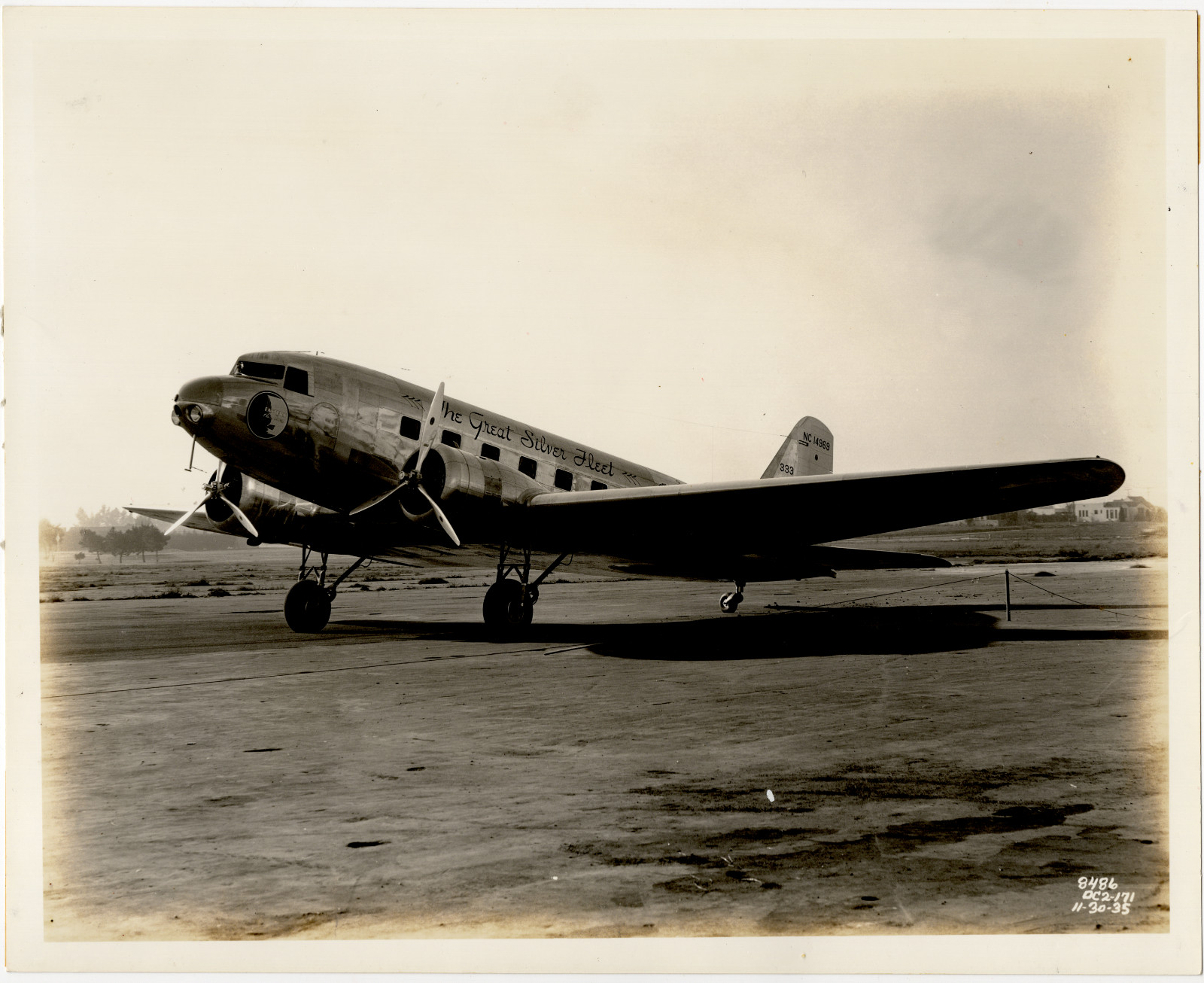
Douglas DC-2 NC14969 Great Silver Fleet Photo
Later RAAF A30-10 ... Written Off in Australia, 1942DESCRIPTIONThis 8x10 photograph shows Douglas DC-2 NC14969 of Eastern Air Lines parked on the ramp in the airline\'s polished aluminum Great Silver Fleet livery. The script The Great Silver Fleet runs along the cabin windows, the round Eastern Air Lines emblem is on the nose, a Wright Cyclone nameplate is visible on the engine cowling, and the tail carries the registration NC14969 with fleet number 333. A caption lettered in white in the lower right corner of the image reads 8486, DC2-171 and 11-30-35. DC-2-171 is the Douglas model designation for this airplane, one of two of that model delivered to Eastern. Published aircraft records give its delivery date as November 15, 1935, which makes this photograph a fifteen day old portrait of a brand new airliner. It is a period print from a collector\'s album of Douglas and Northrop factory photographs, and the original collector is unknown. Scanned at 600dpi.The DC-2 is the airliner that proved the formula the DC-3 would make famous. Douglas built it for TWA after United Air Lines locked up the Boeing 247, and the first one flew on May 11, 1934. It carried 14 passengers at up to 210 mph over roughly 1,000 miles, and it showed that air travel could be comfortable, safe and reliable. Eastern flew 14 DC-2s on its East Coast routes between 1934 and 1941, and this photograph captures one of them in the silver livery the airline would be known for.What makes this particular airplane worth a closer look is that its whole career can be followed. Eastern later sold its remaining DC-2s, ten of them to the Australian government, which bought them as the core of a military transport fleet. NC14969, construction number 1372, was shipped to Australia, assembled by Australian National Airways at Essendon, and taken on charge by the Royal Australian Air Force on March 17, 1941 as A30-10. It served first with No. 1 Wireless Air Gunners School at Ballarat. In January 1942 it was sent back to Australian National Airways to be converted into a cargo transport with a new cargo door, and by April it was with No. 36 Squadron, carrying the civil radio call sign VH-CRD beside its serial. Australian RAAF serial records show that in June 1942 it was flying shuttles from Daly Waters to Batchelor in the Northern Territory, carrying 300 pound bombs for USAAF B-17s, with eight bombs tied to lugs on the cabin floor and the detonators kept in the cockpit. In November 1942 its starboard engine failed on take-off at Mallacoota, Victoria, and the airplane crashed with six airmen aboard, all of them injured. The wreck was broken down for components and in August 1943 was allotted to the Royal Australian Engineers Training Centre at Wagga Wagga as a training aid. One airframe, one photograph, and a path from a brand new Eastern airliner in 1935 to a bomb-hauling wartime transport in the Pacific seven years later.Every effort is made toward fact checking and provenance, including background research through news and historical archives. If any listing is incorrect in any way and you\'re unsatisfied with the item, please connect with me and I\'ll make it right. Orders placed before Noon CDT ship same day via Ground Advantage with tracking so you know exactly when it will arrive. Returns accepted on all items exceeding $25 in cost. All shipments receive rigid, professional packaging, sealed and protected in acid free protectors. Shipping is free and already built into the price, so the BIN price is exactly what you pay, no surprise shipping costs at checkout.CONDITIONBlack and white 8x10 period photographic print with a warm brown tone and good detail. The Eastern Air Lines emblem, The Great Silver Fleet script, the NC14969 registration and fleet number 333 are all clearly readable, and the white caption in the lower right corner is crisp. There is some amber toning along the edge of the image beside the paper margin and a few tiny dust specks and spots in the sky area, as visible in the scans. The lower right corner shown is sharp and square. The reverse still carries adhesive residue and paper left from the album page it was removed from, which does not affect the image side. Please review all photos closely, as they are part of the description.