When you click on links to various merchants on this site and make a purchase, this can result in this site earning a commission. Affiliate programs and affiliations include, but are not limited to, the eBay Partner Network.
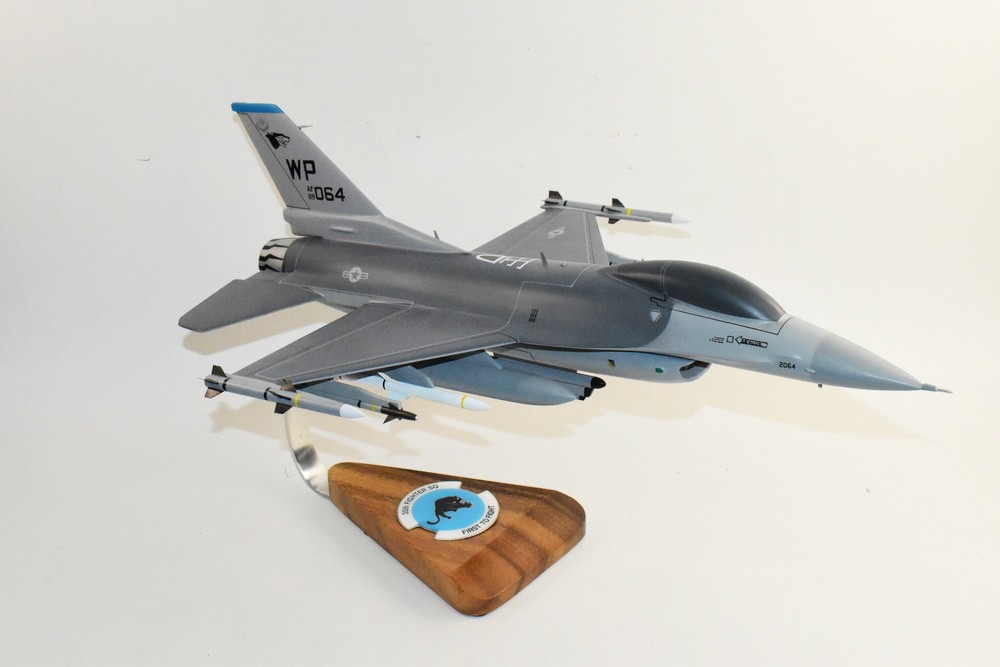
Lockheed Martin® F-16 Fighting Falcon®, 35th FS Pantons
Fly with the 35th FS Phantons in this 18 inch wooden F-16 model. Each model is carefully carved from wood and hand painted to provide a unique piece that you'll love.
- 18 inches/ Made from Mahogany
- US Veteran Owned Business
- Officially Licensed by Lockheed Martin
LOCKHEED MARTIN®, F-16 Fighting Falcon®, associated emblems and logos, and body designs of vehicles are either registered trademarks or trademarks of Lockheed Martin Corporation in the USA and/or other jurisdictions, used under license by Squadron Nostalgia LLC.
The 35th Fighter Squadron (35 FS) is a United States Air Force unit, assigned to the 8th Operations Group, stationed at Kunsan Air Base, South Korea. The squadron operates the F-16 Fighting Falcon aircraft conducting air superiority missions.
The 35th FS is one of two squadrons of Block 40 F-16C/Ds of the 8th Fighter wing at Kunsan, flying the Fighting Falcon since 1981. The 35th is one of the oldest squadrons in the United States Air Force, its history dating to 12 June 1917, when the unit was activated as the 35th Aero Squadron
World War I
The 35th Fighter Squadron heritage dates back to 12 June 1917, when the unit activated as the 35th Aero Squadron. Originally an aircraft maintenance squadron, the unit served in France from September 1917 to February 1919. Upon the unit's return to the United States after the armistice, it demobilized during the American disarmament.
Inter-war years
Recognizing the need for a strong air arm, American defense officials reconstituted the squadron in June 1932 and redesignated it the 35th Pursuit Squadron. For the next few years, the 35th flew P-12, PB-2, A-17, and P-36 aircraft out of Langley Field, Virginia. In 1939, the unit was redesignated the 35th Pursuit Squadron (Fighter) and moved to Mitchel Field, New York, to fly the P-40 Warhawk.
World War II
The 35th FS along with the 8th Pursuit Group and 22nd Airbase Group left San Francisco in Convoy Number 2033, escorted by USS New Orleans, for Australia on 12 February 1942 on the Army transport USAT Maui arriving with the convoy at Brisbane, Australia on 5 March 1942.[3] The squadron has never been stationed in the United States since. They arrived in Brisbane, Queensland on 6 March 1942. After arrival, it moved to Amberly Airfield, west of Brisbane, where it was equipped with P-39D Airacobras that were originally intended to go to the Philippines but the convoy was diverted to Brisbane.
They then moved to Woodstock outside of Townsville in Northern Queensland on 26 April 1942 on their way to Port Moresby, New Guinea where they arrived on 30 April 1942. There, the squadron operated from a gravel fighter strip constructed by the Australians in the 1930s called Kila Kila Airfield (3 Mile Drome). After two months in combat, the squadron rotated back to Australia, returning to Woodstock on 29 June 1942 for various rest and re-equipment tasks. They relocated to Garbutt airfield in Townsville on 27 July 1942 and then moved to Milne Bay in New Guinea on 18 September 1942 after the airfield was secured from the Japanese. It again engaged in combat operations against Japanese forces with its P-39s until rotated back to Queensland, being sent to Mareeba Airfield in February 1943 as its Airacobras were basically worn-out. At Mareeba, the squadron was re-equipped with P-40N Warhawks before leaving Australia for good in May and heading back to Port Moresby.
In New Guinea, the squadron covered landings and supported offensive ground operations in New Britain, New Guinea, and Hollandia, with the group moving forward to different bases as territory was captured from the Japanese. At Cape Gloucester, the P-40s were replaced by P-38F Lightnings that were ferried up from Australia. It was with the P-38 that the 8th Fighter Group became truly effective both against the Japanese Zero in air-to-air battles, as well as providing ground support to MacArthur's ground forces. Its twin engines offered an additional safety factory when operating over long stretches of water and jungle. The Lightnings proved to be extremely rugged and could take a lot of battle damage and still keep flying. Missions lasting 9, 10, or even 12 hours became routine, and many wounded Lightnings were able to limp home on only one engine.
In 1944, the 35th FS supported operations in the Philippines, earning a second Distinguished Unit Citation when, armed only with machine guns, the Lightnings of the 8th Fighter Group strafed a Japanese naval task force for three hours, halting the ships until B-25 medium bombers from more distant bases could attack the task force with low-level bomb runs Despite the fact that the group did not have time to load bombs on its fighters and used only .50 caliber bullets on the mission, the 8th managed to sink one of the Japanese ships.
After moving to San Jose, Occidental Mindoro in the Philippines in December 1944, the 35th spent the next several months conducting offensive operations against Formosa and the Asian mainland, as well as flying escort missions in the area. Moving to a base in Ie Shima in August 1945, the 8th flew several missions against the Japanese island of Kyushu before the war ended.
On 14 August 1945, the day of the Japanese surrender, the 35th Fighter Squadron shot down the last enemy plane of the war. During its involvement in World War II, the 35th participated in nine campaigns.