When you click on links to various merchants on this site and make a purchase, this can result in this site earning a commission. Affiliate programs and affiliations include, but are not limited to, the eBay Partner Network.
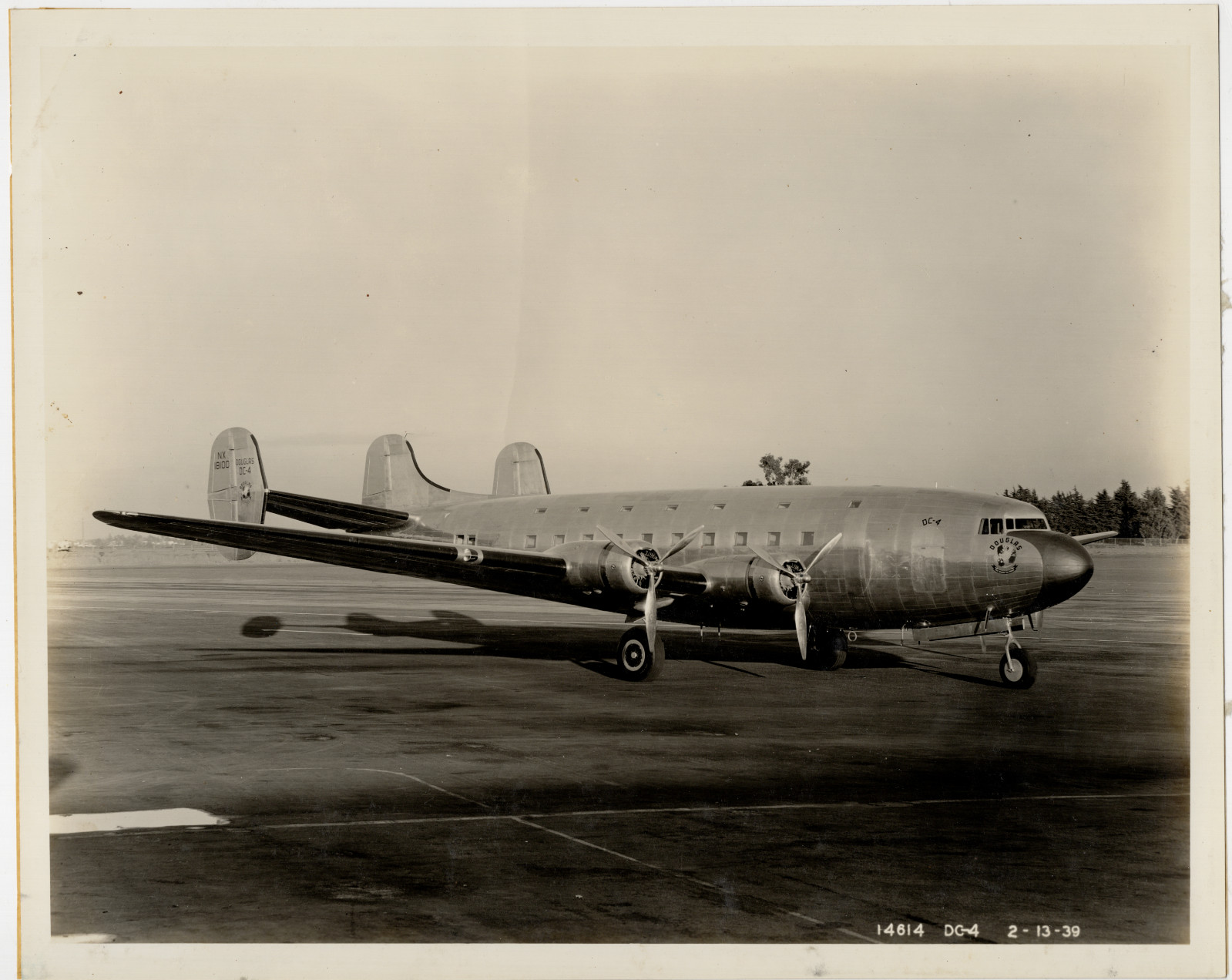
1939 Douglas DC-4E NX18100 Prototype Photo
Only One Built, Sold to Japan
Reported Crashed in Japan, Its Design Became a BomberDESCRIPTIONOriginal period photograph of the Douglas DC-4E, the one-off prototype four engine airliner registered NX18100, from a Douglas and Northrop factory photograph album. The white ink caption in the lower left reads 14614 DC-4 2-13-39. The print shows the nose with the Douglas globe emblem and its First Around the World banner, DC-4 lettering on the fuselage, figures at the flight deck windows, two of the four radial engines with three blade propellers, and the tail marked NX 18100 DOUGLAS DC-4. Images were scanned at 600 dpi.The DC-4E began in 1935, when United Air Lines asked Douglas for a transport about twice the size of the DC-3. American, Eastern, Pan American and TWA each committed $100,000 to the project. The result carried 42 passengers by day or 30 in a sleeper layout, with tricycle landing gear, new for an aircraft of its size, a triple tail, and four 1,450 horsepower Pratt & Whitney Twin Hornet engines. It first flew on June 7, 1938 from Clover Field in Santa Monica with Carl Cover at the controls. This print is dated 2-13-39, while the airplane was still in flight testing and about three months before its type certificate was approved in May 1939. It still wears the NX prefix of an experimental registration, and the tail and fuselage still read simply DC-4. The E for experimental came later, after Douglas drew up a smaller, simpler four engine design that took the DC-4 name. The globe emblem on the nose recalls the 1924 Douglas World Cruisers, the first aircraft to fly around the world.United flew the prototype on evaluation in 1939. On June 9, 1939 it visited Wright Field in Dayton, Ohio, where Orville Wright met Carl Cover and United's chief engineer W. F. Mentzer, and Wright is reported to have ridden as a passenger on a flight over the city. United found the airplane capable but complex and costly to maintain, and it never entered production. The sponsors backed the smaller design instead, which became the DC-4 and the military C-54 Skymaster, with more than 1,100 C-54 and R5D versions built.The prototype's story did not end there. In late 1939 it was sold to Japan, officially for a Japanese airline. Registration records show its certificate was issued in May 1939 and cancelled that October when it was exported to Japan. Reports said it had crashed in Tokyo Bay, but accounts of its fate say the Imperial Japanese Navy had it passed to Nakajima to be dismantled and studied. Its wing form, tricycle landing gear and engine arrangement carried into the Nakajima G5N Shinzan, a four engine bomber the Allies code named Liz. Six were built and none entered full production. This is a photograph of the only DC-4E that ever existed, taken during the months its design was still being proven.Every effort is made for fact checking and provenance, including background research through news and historical archives. If any listing is incorrect in any way and you're unsatisfied with the item, please connect with me and I'll make it right. Orders placed before Noon CDT will ship same day Ground Advantage with tracking so you know exactly when it will arrive. Returns accepted on all items exceeding $25 in cost. Rigid, professional packaging on all shipments, sealed and protected in acid free protectors. Shipping is free and already built into the price, so the BIN price is exactly what you pay, no surprise shipping costs at checkout.CONDITIONOriginal period black and white photograph, approximately 8x10 inches, with a white border and the white ink caption 14614 DC-4 2-13-39 in the lower left. The image is sharp, with clear detail in the nose emblem, tail registration and engine cowlings. There is light warm toning along the right side of the image area, scattered fine dust specks and hairline surface marks, and a thin soft light line crossing the pavement near the caption. The border and corners show light handling wear. The reverse has amber adhesive residue from its former album page, patches of gray album paper fibers along the edges, a small piece of translucent tape folded at one corner, and a small area along one edge where the bare paper shows. The residue is on the reverse only. No stamps or writing are visible on the back. Please review all photos closely, as they are part of the description.